Showing posts with label exynos. Show all posts

Watch the launch of Samsung Galaxy Note 5 LIVE!


Samsung is now hosting a Unpacked event launching Note 5 and Galaxy S6 edge plus.
I will post the details and specs after launch and not spoil the surprise.
Here is live stream:

Samsung Galaxy S6 Plus photos leaked !

Samsung Galaxy Edge
Samsung’s Galaxy Note 4 is the only Samsung smartphone so far that can’t be accused of copying Apple’s iPhones, but its successor might not be the hottest new phablet out of South Korea this year. With many Android fans eagerly awaiting the September debut of the Galaxy Note 5, their attention has suddenly turned to the “Galaxy S6 Plus,” another new phablet Samsung will seemingly launch this year. And if the rumors pan out, it’ll debut much sooner than the Note 5.

Samsung Announces The Galaxy S6 Active

Today Samsung and AT&T announced the Galaxy S6 Active, a variant of the Galaxy S6 with a greater focus on durability and ruggedness. Releasing an Active version of their flagship Galaxy device has become a tradition for Samsung since the Galaxy S4, and it looks like this year is no exception. While it differs in its construction and design, I think people will find that its specifications are quite familiar.

Samsung tablet with Intel Atom x5 chip, 4GB RAM spotted in benchmark

A Geekbench listing of a mysterious Samsung tablet codenamed CHOPIN-LTE made the rounds online. The slate houses a 64-bit Intel Atom x5-8500 chipset with 2.24 GHz quad-core CPU codenamed “Cherry Trail.” The silicon will utilize 14nm architecture.


The upcoming tablet features an Intel XMM 726x LTE modem alongside the Atom x5-Z8500 mobile chipset clocked at 2.24GHz and can drop to 1.44GHz . It packs a whopping 4GB of RAM and boots Android 5.1 Lollipop.For the record, intel Atom x5 Z8500 packs Intel Gen 8 graphics with 12EUs  (Broadwell Gen),the GPU clocks from 200MHz to 600MHz.

Although the benchmark score seem low,the final hardware may be much higher in perfomance.

Samsung introduced high-end Galaxy tablets with its own Exynos chipsets last year, though, this time around, the Korean giant appears to have other plans. We will keep an eye out for more details on the slate going forward.

Samsung Galaxy S6 Active possibly caught in the wild

Today two images of what’s claimed to be the Galaxy S6 Active have been leaked online, possibly offering us the first look at the Galaxy S6′s rugged sibling.

Meizu MX5 pictured in the wild !


As the rumor has it, the Meizu MX5 is going to premiere at a press event on June 30, but this is yet to be confirmed by the manufacturer. And while we are waiting for some official news on the flagship we saw the Meizu MX5 leak with specs, live pictures and even some (dreamy) bezel-less renders.

Meizu MX5's fingerprint sensor said to be similar to that of M1 Note 2

Just days after there were reports that the Meizu MX5 will be announced on June 30, new details have emerged about the company's upcoming flagship smartphone.
According to a new report out of China, the handset will feature a fingerprint sensor similar to the one being rumoured in the M1 Note 2, which is said to be unveiled on June 2. Another rumour is that the flagship's body will be made out of metal, instead of plastic.
Needless to say, none of this has been officially confirmed, so take it with a pinch of salt.

Alleged press image of Samsung Galaxy Tab S2 leaks out

Purported live photo of the upcoming Samsung Galaxy Tab S2 tablet made the rounds on Twitter, courtesy of @OnLeaks. The Korean giant’s full-size tablet is rumored to make its official debut at some point in June.
Overall, it appears that Samsung Galaxy Tab S2 will feature similar design language as the Galaxy S6 smartphone. This should hardly catch anyone by surprise - last year’s Samsung Galaxy Tab S rocked the same design as the Galaxy S5.
The leaked image appears to showcase a slate with cellular network connectivity. A SIM card slot and a microSD card slot are sitting side by side.
Past rumors have suggested that Samsung Galaxy Tab S2 might be thinner than iPad Air 2. Alleged specs of the slate include 9.7” display with 2048 x 1536 pixels (like recent iPads and the Nexus 9), 3GB of RAM, 32GB of built-in storage, 8MP rear camera, and 2MP front snapper. The chipset is going to be a Samsung Exynos solution with octa-core CPU (probably exynos 7420). 

Updates:Samsung and Dell push out software updates

Samsung has pushed out new update to Samsung Galaxy S6.The OTA has an Android version 5.0.2, which the device already received last month, but now comes with noticeable improvement to the phone's performance.

As some of you might remember, a lot of Galaxy S6 users have been reporting some severe memory issues and drops in performance. Samsung recognized the problem and promised to remedy it in future micro updates. Judging from the improved stability and speed of the unit, we can fairly safely state that the memory leak was handled after the update.
The package itself has a build number of G920FXXU1AODG and weighs precisely 138.32 MB. Its change log is quite vague, so we can't say for sure what improvements and fixes it brings, but, like we said, the Galaxy S6 is now a lot snappier.If you have any more info on the OTA in question and the alleged S6 memory leak, be sure to let us know in the comment section.
Dell pushes out Android 5.0.2 update for Venue 8:
Dell has started pushing out the Android 5.0.2 Lollipop update for the Dell Venue 8 7840. You can check if the update is available for download from the Settings app.


Like the KitKat version before it, Lollipop on the Venue 8 seems to be unadulterated and close to stock Android. According to Android Police, it does enable encryption by default, which we have seen in the past causes some drop in performance, but it remains to be seen if that holds true for the Venue 8 as well.If you have the device, check if the update is available.

Samsung Galaxy Tab S2 will be announced in June

As most of you surely remember, Samsung has been hard at work on the successors to the premium Galaxy Tab S duo. The Tab S2 will come in two sizes - an 8.0-inch and a 9.7-inch one and will utilize 4:3 aspect ratio screens. Industry sources now hint at a June announcement for both tablets, so, it shouldn't be long now before Samsung's high-end tablet lineup gets the update.


Both sizes of the Tab S2 are expected to come in a Wi-Fi-only, as well as a Wi-Fi + LTE variants, which amounts to a total of four new devices. According to previous rumors, the new tablets will be exceptionally thin, even thinner than the iPad Air 2. The alleged measurements are 237.1 × 168.8 × 5.4 mm for the smaller one and 237.17mm x 169.58mm x 5.4mm for the other. This would not only make the device “razor thin”, but would, effectively crown it the thinnest Samsung tablet to date. They are pretty light as well, at 260 grams and 407 grams respectively.
As far as the alleged specs sheets go, the slates should feature 2,048 x 1,536 pixel screens, just like recent iPads and the Nexus 9. Both devices should also be powered by one of Samsung’s own Exynos chipsets, which has a big.LITTLE CPU configuration, with four Cortex-A57 cores and four Cortex-A53 ones. The maximum clock speed will be 1.9 GHz. The GPU is a hexa-core Mali-T760MP6. RAM and camera, however, seem to be directly borrowed from the current Galaxy Tab S. That is 3GB for RAM and an 8MP camera.

Samsung's new custom CPU cores 45% faster than A57

Samsung has undoubtedly secured its top-dog position in terms of current gen mobile SoC performance. The latest Exynos 7420, powering the Galaxy S6 and S6 edge has proven itself more capable than anything Qualcomm or Mediatek currently have to offer. But, in today's fast-paced mobile realm tides can shift almost instantly and Samsung doesn't intend to let its competition catch up.
A few weeks ago, we heard a rumor, that the Korean giant is currently hard at work on a custom CPU core design of its own. This is, actually the next logical step in evolving the company's own Exynos chipset family, as, even though, the Exynos 7420 is manufactured with proprietary Samsung technology, it is still based on standard Cortex A57 and A53 cores.


The new silicon, codenamed Mongoose, is said to employ an entirely different architecture altogether and according to some preliminary benchmarks and estimates, in churns out 45% better single-core performance than the Exynos 7420. As far as we currently know, the 64-bit Mongoose chips should cover an ARMv8 instruction set and offer clock speeds of up to 2.3 GHz. There is, however, a lot more that contributes to a mobile chip's performance and proper heat management is another key factor. Samsung has led us to believe that Mongoose will be build using 14nm FinFET technology, just like the current Exynos 7420.
In other words, Samsung, needs to really implement things right, or else it might risk causing another overheating fiasco, like the one still plaguing the Qualcomm Snapdragon 810. Another interesting rumor concerning the upcoming chips is that Exynos M1, which will supposedly be the first Mongoose chip, might employ a Heterogeneous System Architecture. This would be an exciting step forward for mobile tech, as the concept of employing GPU processors for genera-purpose calculations has really caught on lately. Furthermore, Samsung is, in fact, part of the HAS Foundation, along with other major industry names, like AMD, ARM, Imagination Technologies, MediaTek, Texas Instruments and Qualcomm, which makes the leap to heterogeneous computing all that more plausible.


As far as availability goes, industry source estimate that the first Mongoose chips might enter into mass production in 9 to 12 months. If Samsung sticks to its standard release schedule, this could mean that the company's next flagship device, presumably the Galaxy S7, will be the first to use the novice architecture.

ARM reveals Cortex A72 architecture details

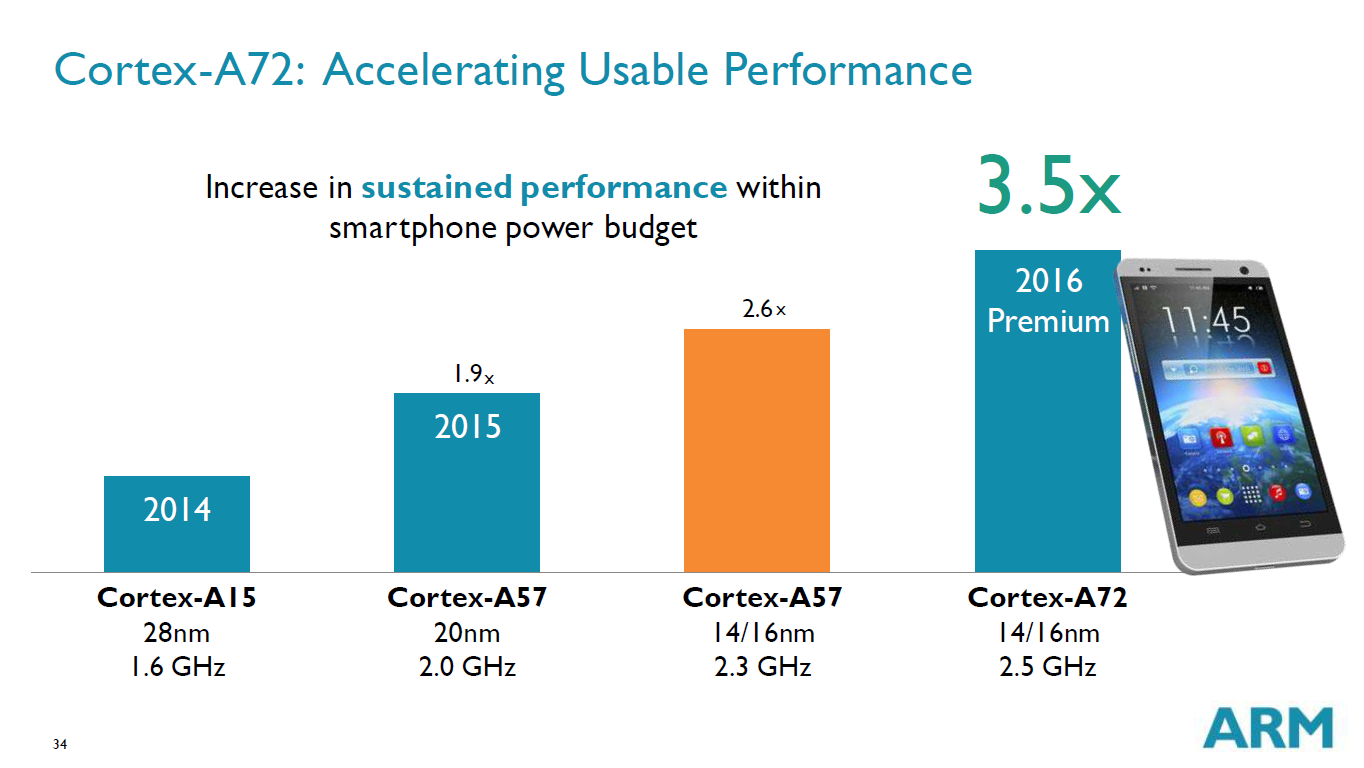
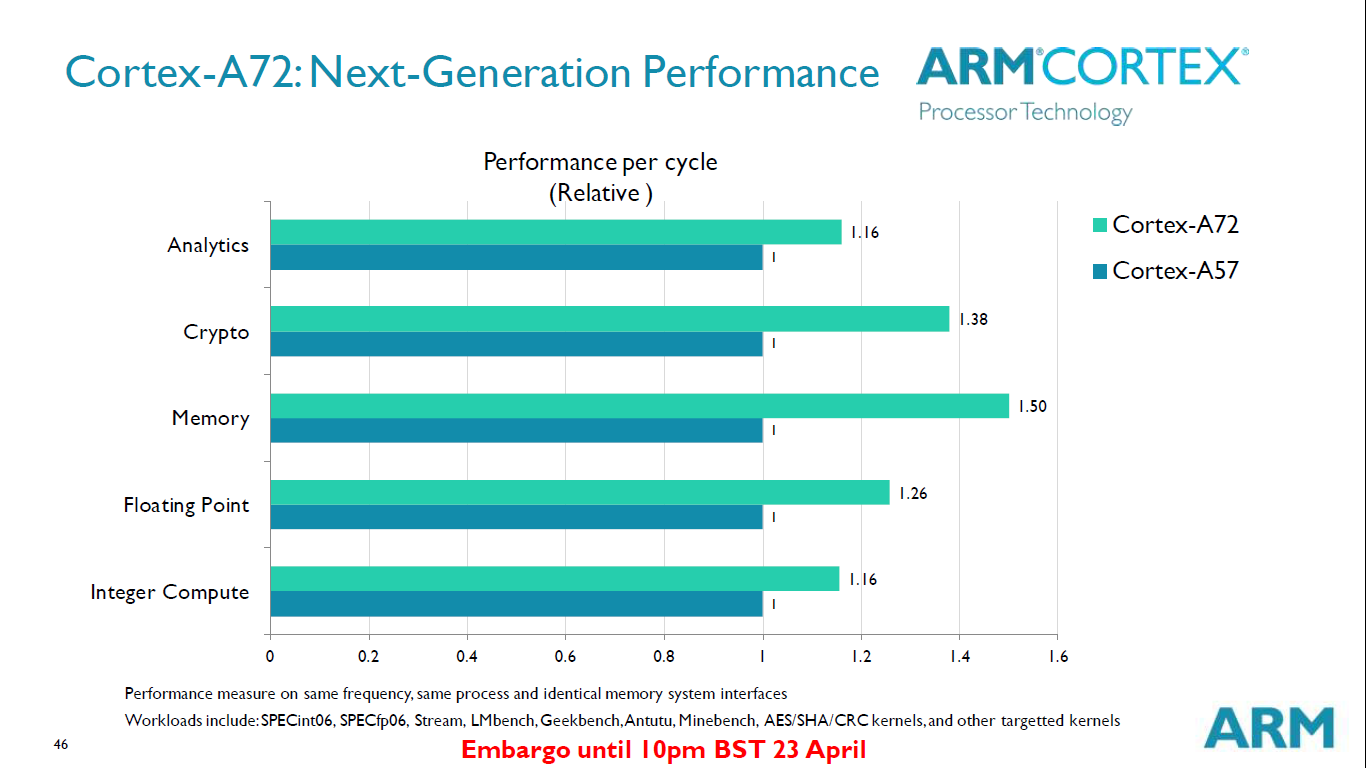
As part of ARM's TechDay 2015 event we had the pleasure to get a better insight into ARM's new Cortex-A72 CPU. ARM had announced the Cortex-A72 in the beginning of February - leaving a lot of questions to be asked and sense of mystery in the air. The Cortex-A72 is a direct successor to the Cortex-A57 - taking the predecessor as a baseline in order to iterate and improve it.


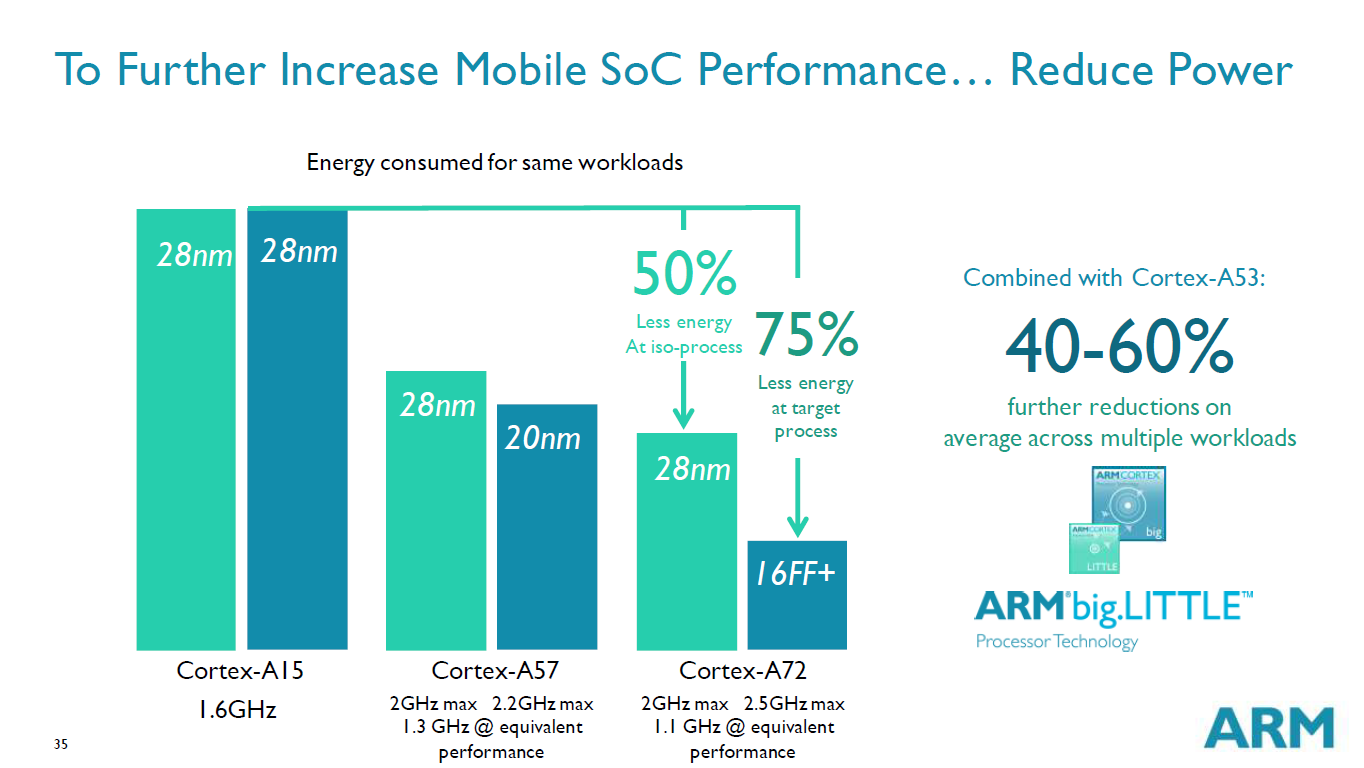
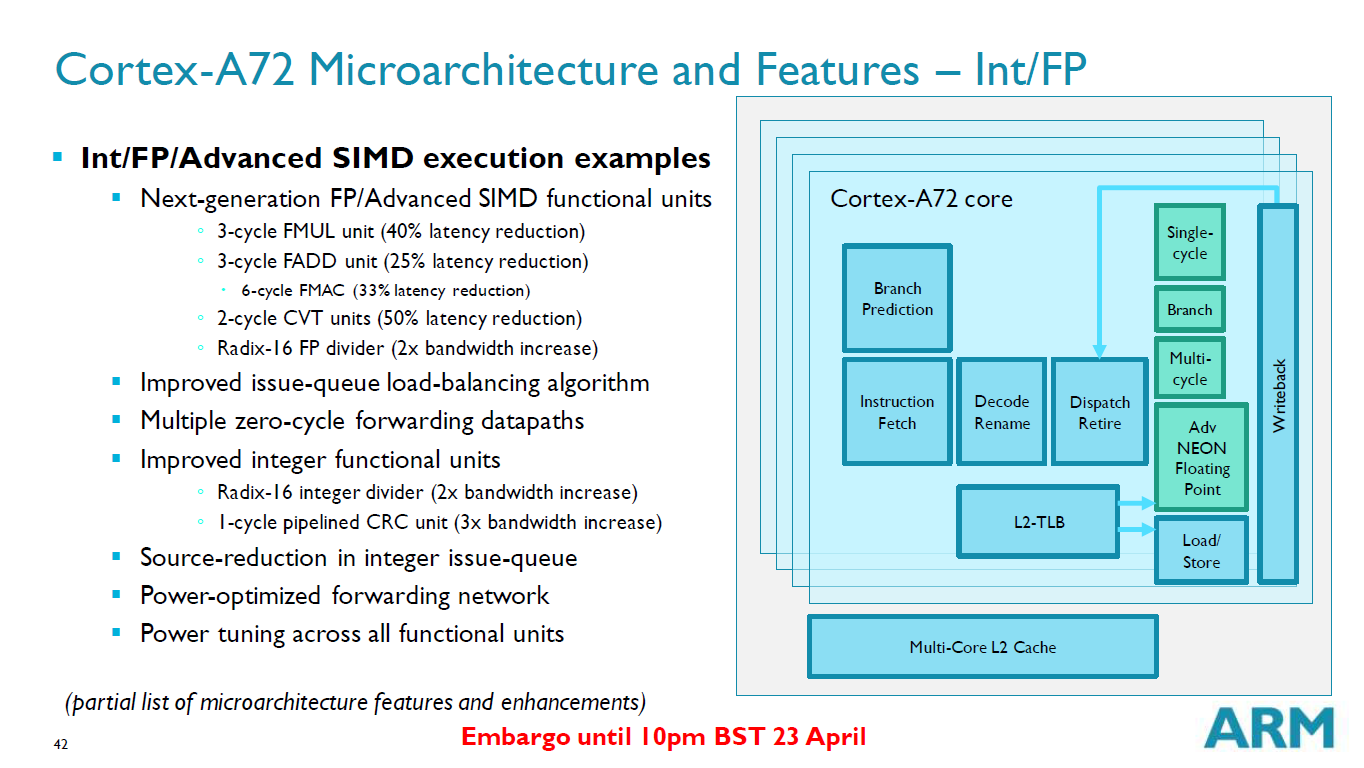
ARM Cortex-A72 offers 20% better branch prediction than its predecessor. Instructions-per-clock have increased between 20% and 60% over the Cortex-A57 depending on the workload. In terms of energy efficiency, the newcomer is between 18% and 30% better than the previous model.

Probably the most interesting slide next to the actual performance metrics of the A72 is the apples-to-apples comparison of the A57 to the A72 on the same process node. When on the 28nm node, we see the A72 having a respectable 20% power reduction when compared to the A57. As a reminder - we're talking about absolute power at the same clock speed, which does not consider performance and thus not a representation of efficiency.
ARM CPU Core Comparison
Cortex-A15Cortex-A57Cortex-A72
ARM ISAARMv7 (32-bit)ARMv8 (32/64-bit)
Decoder Width3 ops
Maximum Pipeline Length19 stages16 stages
Integer Pipeline Length14 stages
Branch Mispredict Penalty15 cycles
Integer Add2
Integer Mul1
Load/Store Units1 + 1 (Dedicated L/S)
Branch Units1
FP/NEON ALUs2x64-bit2x128-bit
L1 Cache32KB I$ + 32KB D$48KB I$ + 32KB D$
L2 Cache512KB - 4MB512KB - 2MB512KB - 4MB

Slides courtesy of AnandTech
Another large performance improvement over the A57 is found on the Load/Store unit. Here, ARM claims that bandwidth to L1/L2 has been improved by up to 30%. This was achieved by introducing a sophisticated L1/L2 data prefetcher which, again, is at the same time more efficient as improvements in the L1-hit pipeline, forwarding network, and way-predictor reduce the needed power.The A72 looks to be a logical update to the A57 addressing some weakpoints such as peak power and power efficiency combined with an ~10% area reduction. We already saw Mediatek showing off an A72 package at MWC, so it will be interesting to see how the IP actually performs in silicon and what ARM's partners will be able to do with the core and the time to market.

Samsung confirms its next smartwatch "Gear A" has round screen

Samsung has released a lot of smartwatches so far, but it's reportedly taking its time with the next one, wanting to get it just right. The device is codenamed Orbis, and will be sold as the Gear A. It will come with a round screen, unlike all of its predecessors.
The Orbis (or Gear A) has been leaked a lot so far, but today Samsung has actually confirmed that it will have a round display. The company did the deed through an official press release announcing that the software development kit (SDK) for its next smartwatch will be out before the wearable itself launches.
This is done in a bid to convince developers to write apps for the watch, and have as many of those as possible available straight from its release day. Developers who are interested to take part in this effort can sign up at a dedicated website, and then wait for Samsung to contact them with more details.
The giveaway is in the image attached to said press release, which features only round app examples. So at least this is clear now. What's left to happen is for Samsung to actually announce the Gear A, and there's currently no telling when that will occur.
From past leaks we know that the Gear A may be powered by Samsung's Exynos 7420 chipset, the same one employed by the Galaxy S6 and S6 edge. The smartwatch will get a version with 3G connectivity and voice call support, and it should sport wireless charging.

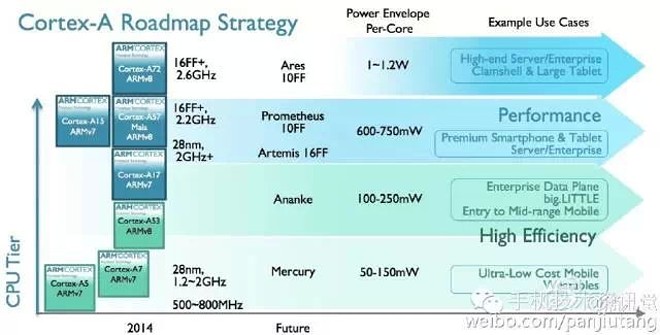
New ARM roadmap leaks with 16nm FinFET and 10nm designs with updated modules

A rather interesting slide has surfaced today on Weibo, which seems to reveal ARM’s future roadmap for processor core designs. From the looks of things, the company’s lineup is in for a major overhaul, which is sure to affect the whole mobile industry, as ARM’s Cortex designs are widely employed by most mobile chip makers.The graph suggests that there will be five new core designs, all bearing catchy Greek mythological names. But, besides an optimization for smaller production processes, like 16nm FinFET and 10nm, the new cores also fill the gap between the current Cortex-A57 and Cortex-A53 with a whole new tier of chips.
At the very top of the food chain, ARM will be introducing Ares cores. They will be replacing Cortex-A72 and, as such, are also intended for use in high-end server and embedded tech and large tablets. They are intended for usage with a 10nm manufacturing process and with a power envelope of 1-1.2W per core.
Right after that, we see another 10nm chip, codenamed Prometheus. It is intended to replace the current Cortex-A57 and will most-probably be powering top-of-the-line mobile chips for smartphones and tablets in the future. It is intended for a power envelop of 600-750mW.
But, the most-notable change in technology will occur in the mid-range, where a whole new tier will broaden choice for chip developers and manufacturers and consequently, end users. ARM currently offers two chips in this segment – the 32-bit Cortex-A17 and the extremely popular Cortex-A53. They will be replaced by three new processor designs.
First up, there is Artemis, which, performance-wise, should fit somewhere between the current Cortex-A57 and the Cortex-A17. It will be designed to be used with a 16nm FitFET manufacturing process and should aim for a power envelope of 600-750mW.Going further down the list, we find Ananke, which sits right below Artemis and should fill in for Cortex-A17 and Coretex-A53 in most use cases. As such, it will feature big.LITTLE support and will, most-likely, be the next most-widely spread midrange processor to power a huge range of mobile devices. It is still not clear what manufacturing process Ananke will be intended for, as the graphic lacks this information. Perhaps, the question is not entirely sorted out yet.Last, but not least, there Is Mercury, which should replace some slower implementations of the Cortex-A53, as well as, the Coretex-A7 and Cortex-A5. Naturally, it is intended to power ultra-low-cost mobile devices and the new emerging segment of wearable tech. It is aimed for a power envelope of 50-150mW per core.

There is also details about new GPUs and Core Link (core scheduler) which will twice the performance compared to current top GPU and core link from ARM.
More Details : Source 

Meizu MX3 officially announced with 5.1-inch 1800x1080 Screen,Exynos 5 Octa and up to 128GB of storage


The day has come. Meizu has finally announced its latest flagship smartphone, MX3, and just as we’ve told you, it will be available in an array of options with built-in storage ranging from 16 to 128 GB. In addition, it also sports a 5.1-inch screen with rather impressive 180×1080 pixels resolution, Samsung’s Exynos 5 Octa chip, 2GB of RAM and an array of connectivity options. There’s also Meizu’s own Flyme UI 3.0 that runs on top of unspecified version of Android (we guess it’s 4.2.2). Price wise, the 16GB model will sell for an equivalent of $410 while the 128GB version will get $650 out of your hard-earned money.


Samsung Galaxy S4 goes official

Samsung just released its latest flagship - the Galaxy S 4. It packs a new 4.99" Super AMOLED screen with a resolution of 1920 x 1080 pixels, which adds up to a pixel density of 441ppi. The screen still a new PenTile matrix, though it probably won't matter much at this kind of density.


Samsung Galaxy S 4 in White Frost


The international version of the Samsung Galaxy S IV is going to be powered by the Exynos 5 Octa chipset, which features four Cortex-A15 cores clocked at 1.8GHz, four Cortex-A7 cores running at 1.2GHz and the PowerVR SGX 544MP3 GPU. There will be a second version for some markets, which will be powered by the Qualcomm Snapdragon 600 chipset with its 4 Krait 300 cores and Adreno 320 GPU. Both versions will offer LTE connectivity and 2GB of RAM.


Samsung Galaxy S 4 in Misty Black


At the back, the Samsung Galaxy S IV will feature a 13 MP sharpshooter, while on the front a 2.1MP camera will take care of video chats and a host of new features that involve eye-tracking and hand-tracking.


The Samsung Galaxy S IV is slimmer than the Galaxy S III at 7.9 mm and even though its screen has grown it's actually narrower than its predecessor thanks to the slimmer bezels. The smartphone features a similar hyperglaze finish to its predecessor, though it has a different pattern on the back. At 130g the Galaxy S IV is also lighter than the Galaxy S III, despite featuring an ampler 2600mAh battery.


The new Samsung flagship will have three options for its internal storage (16GB, 32GB and 64GB) and they will all feature a microSD card for further expansion.


Just like the HTC One the Galaxy S 4 incorporates an IR blaster so you can use it as a remote control with your TV and various other home appliances.


Samsung Galaxy S 4 live photos


Samsung Galaxy S 4 runs on Android 4.2.2 Jelly Bean and has several cool new software features to go with. There's Sound and Shot, which captures 9 second clips with sound (similar to the HTC Zoe), Drama Shot, which captures a burst of photos and combines them into a single image. Cinema Photo mimics Nokia's Cinemagraph and lets you shoot a video and then select which part to be animated and which static, resulting in a GIF image.


You can erase objects from a picture and record video simultaneously from the front and back camera (1080p).


Samsung has included S Translator, which works with email and ChatON. It can translate all major languages at launch with further ones coming later on.


Smart Pause pauses the video you're watching if it detects that your eyes are away from the screen, while Smart Scroll can scroll a web page if you tilt the device while looking at it.


Health and Wellness is part of the Samsung Galaxy S 4 improved TouchWiz package too. The S Health app can measure steps, calories and even the confort of your surroundings - temperature, humidity, etc. These features require the S Band and Heart Rate monitor accessories.


The Samsung Galaxy S 4 will hit shelves in April in two colors - White Frost and Black Mist. Pricing is yet to be confirmed.

Samsung to ditch Exynos & AMOLED for Snapdragon 600 & SoLux display in S4


Samsung Galaxy S4 Samsung to ditch Exynos & AMOLED for Snapdragon 600 & SoLux display in S4: ReportSamsung Galaxy S IV has become one big mystery. As we get to closer the rumoured official announcement on March 14, more and more new details about the Galaxy S IV smartphone are coming out. Not sure if all of these are accurate, but the latest one is particularly interesting.


SamMobile is reporting that Galaxy S IV will be packing the Qualcomm Snapdragon 600 processor in all Galaxy S IV variants instead of the rumoured Exynos 5 Octa in GSM versions. Samsung has traditionally used self-made Exynos processors in Galaxy S series smartphones as it is able to control the supply and does not have to be dependent on other manufacturers to provide it chips for such an important smartphone in its portfolio.


SamMobile notes that the Korean manufacturer has found heating issues with Exynos 5 Octa processor forcing it to move to Snapdragon 600. The Qualcomm chip is a great performer and we have seen that in the benchmarks of HTC One smartphone, which also packs the same SoC.


If this rumour is indeed true then it makes sense for Samsung to switch to Qualcomm processor rather than having a faulty chip in its flagship smartphone.


Another interesting piece of information coming out today indicates that Samsung is also ditching AMOLED for LCD in Galaxy S IV. It is even more surprising but for this decision SamMobile blames the problems Samsung is having with the production of full HD AMOLED panels. According to the publication, Samsung is using 1080p SoLux display in S4, which was also previously rumoured to appear in HTC One, but that did not happen. We know nothing about the SoLux display, but chances are that it is some form of LCD.


There is no way to verify these rumours, but SamMobile has a pretty neat record with Samsung related reports, making the current rumours worth reporting, but we would still wait for the March 14 to believe them.


In related news, Galaxy S IV is also expected to come with 13MP camera, aluminium frame, and removable battery.


To recap, the latest rumoured indicate the following specs for Galaxy S IV:


  • 1.9GHz quad-core Qualcomm Snapdragon 600 processor

  • 4.99-inch 1080p SoLux display

  • 2 GB RAM

  • 16/ 32/ 64 GB internal storage

  • 13MP camera

  • 140.1 x 71.8 x 7.7mm, 138 grams